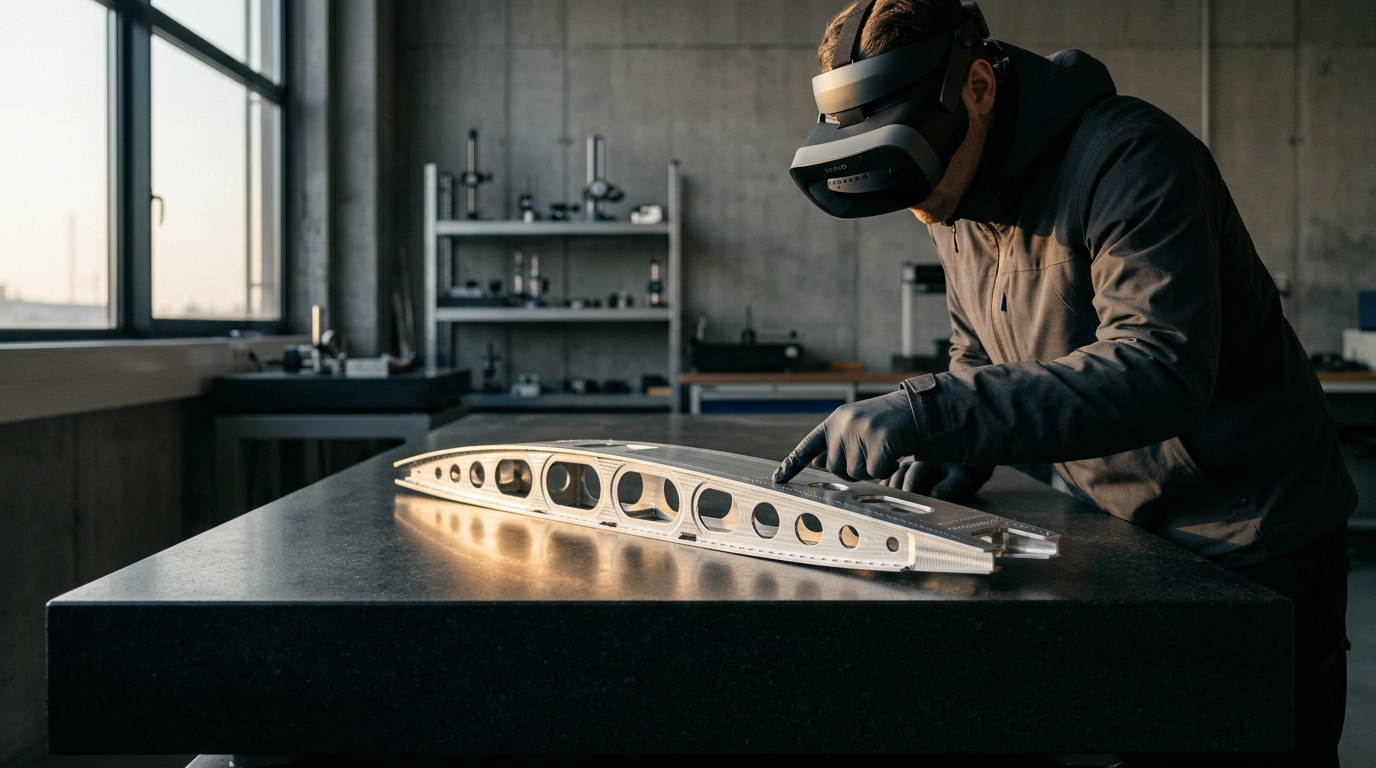
Augmented reality for quality control in manufacturing superimposes CAD tolerances onto the part, traces deviations by photo, and raises defect detection rates by 20 to 35%.
A machining workshop, a Tuesday morning
A machined part comes off a machining centre. The inspector opens the paper drawing, picks up a calliper, checks five dimensions, misses two, approves the part. Three weeks later, the customer returns the batch for non-conformance on a rarely checked dimension. The cost of the return exceeds that of the original inspection by a factor of ten. This scene repeats itself daily in aerospace, automotive and boilermaking workshops. Quality control does not fail through lack of skill: it fails because the operator juggles a 2D drawing, a 3D part and fallible memory. Augmented reality for quality control addresses this point of friction.
How augmented reality changes the inspection gesture
Superimposing CAD onto the real part
Quality control with augmented reality works by projecting the CAD model onto the part, at 1:1 scale, via a headset or tablet. The operator sees critical zones highlighted, tolerances annotated, dimensions to measure in the prescribed order. The spatial interface anchors the data to the object it describes — where the paper drawing required a mental translation. Useful when the part is complex, when the inspection zones are numerous, or when the inspector has just been trained.
Guide, measure, trace in a single flow
The second contribution is traceability. Each validated dimension triggers a timestamped photo, attached to a part identifier, filed in the quality record. No more recopied inspection sheet. No more missed dimension. No more doubt about the history. See, measure, record: the sequence becomes a single hands-free gesture.
Detect what the human eye misses
On multi-component assemblies, augmented reality reveals millimetre-level deviations that the eye no longer perceives at industrial pace. Sites equipped in aerospace and automotive report defect detection rates rising by 20 to 35% in the first months. The gain comes from a protocol made visible, shared and uninterrupted — not from a miracle technology.
Concrete industrial use cases
Aerospace — composite structure assembly. On a wing rib, the operator checks the alignment of dozens of fasteners. The CAD overlay indicates each expected hole, its angular tolerance, its target torque. Out-of-spec fasteners are identified within seconds. The electronic manufacturing record is completed as the inspection progresses.
Automotive — foundry part incoming inspection. On an aluminium casing, manual dimensional inspection took twelve minutes per part. With an augmented reality tablet and edge-tracking vision, the time drops below six minutes, with a wider dimension coverage. The inspector no longer memorises the sequence: they follow it.
Energy — weld inspection on pipework. During a pipe section replacement, weld conformance is mapped by superimposition. Each inspected bead is tagged, photographed, signed. The project completion record becomes accessible in augmented reality to any auditor.
Points to watch
Augmented reality does not replace the metrologist on critical-class parts. For tolerances below a few tenths of a millimetre, an instrumented measurement remains necessary. Fixture of the part is the most demanding step: a poor anchor of the model leads to false positives, not savings. For long headset sessions, eye fatigue must be anticipated through short cycles. Integration with the existing quality system — ERP, DMS, SPC software — determines the return on investment. An application disconnected from the manufacturing record reduces the protocol to a demonstration.
Conclusion
Augmented reality does not transform the inspector's trade: it makes it visible, sequential and traceable. It is useful when parts are complex, when volumes prevent exhaustive CMM inspection, or when team turnover weakens knowledge transfer. Myxed accompanies several industrial sites on this scope, from isolated parts to assembly lines. Deployment holds when the application is not one more tool, but the inspection gesture itself.
Frequently asked questions
For quality directors and production managers.
It depends on the gesture. On a part laid flat, the tablet is sufficient and simpler to deploy. On an overhead assembly or in a constrained posture, the hands-free headset becomes essential. Myxed is agnostic by design: headset, tablet or a combination are chosen according to the use case, not the available technology.
Anchor precision is around one millimetre on a well-marked part. That is sufficient for presence checks, alignment, assembly sequence or weld inspection. Below that, an instrumented measurement completes the process: connected calliper, probe, scanner.
A use case scoped to a defined part family can be prototyped in four to eight weeks. Operational deployment on a line — with integration into the electronic manufacturing record — takes a few months. Adoption is faster when operators participate from the scoping phase.