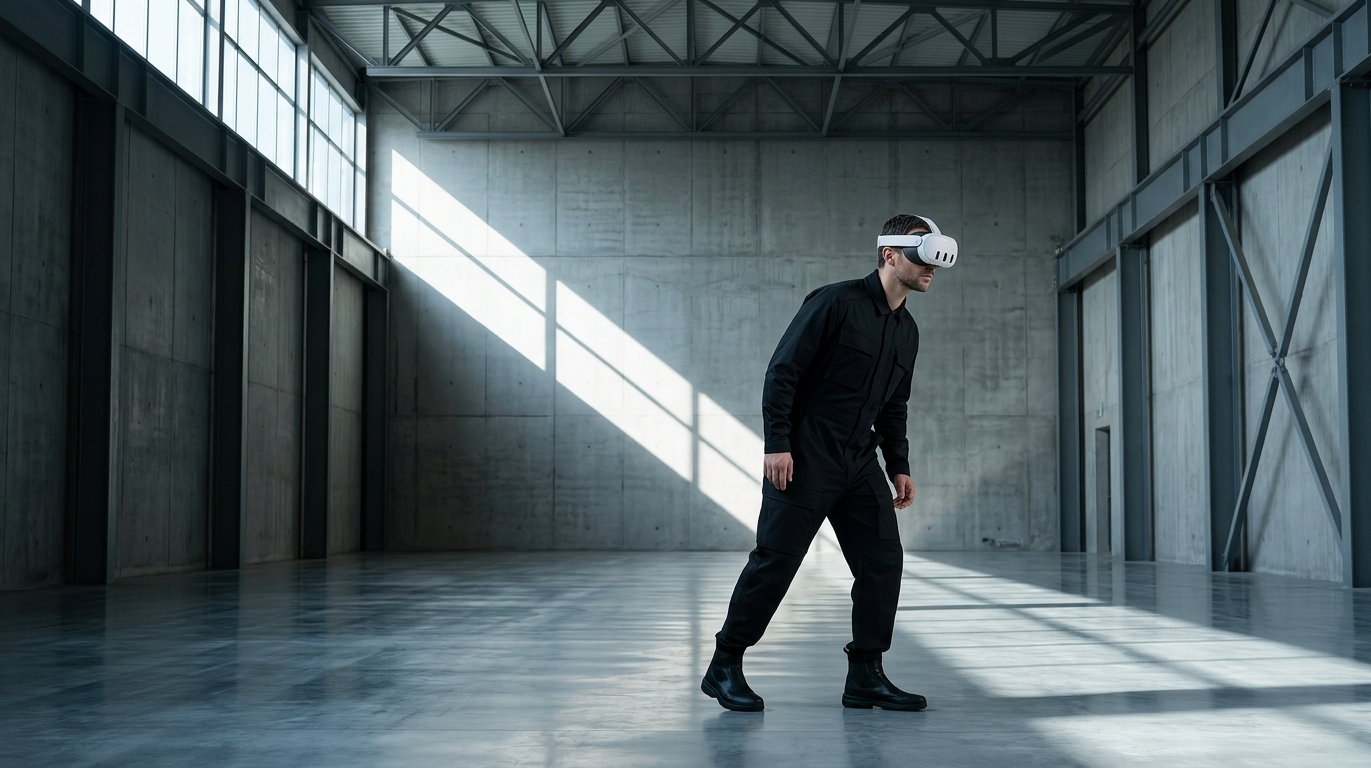
Technical field training through industrial XR
Some tasks cannot wait for a scheduled training session. Some equipment is too rare to set aside for teaching purposes. XR training addresses exactly these situations.
Results measured across deployments
Everyday constraints
When classroom training hits its technical limits
A maintenance technician has to work on equipment they have never touched. The equipment is in production. Technical documentation exists, but it does not teach the motion. Classroom training does not reproduce the physical constraints of the workstation. Mentoring assumes an expert is available, on site, at the right moment.
These constraints are not exceptional. They describe the everyday reality of industrial maintenance in high-demand sectors: aerospace, energy, defense, petrochemicals. The tasks are complex, the equipment is costly, and errors carry measurable consequences.
Industrial XR training resolves this tension. The technician trains on a digital twin of the equipment, under conditions identical to the real workstation. The module guides each step, logs each action, and flags each deviation. They arrive on site with the motion already ingrained.
This approach is part of our broader offer in industrial XR training for production teams.
Simulation fidelity
Faithful simulation, no production downtime
Simulation fidelity is the deciding factor. An XR module that oversimplifies the environment does not prepare technicians for the real thing.
Myxed builds its simulations from the client's own 3D equipment data: CAD models, point clouds, field surveys. The virtual environment reproduces the real physical constraints: footprint, accessibility, sequencing of operations.
The technician sees their hands in the simulated environment. They interact with components in the correct order. If a step is missed or reversed, the module flags it and asks for the action again. Tolerance is configured to the client's required level.
This level of fidelity opens up training for rare tasks: a maintenance operation performed once a year on strategic equipment. It also covers dangerous tasks: live electrical work, work at height, intervention in ATEX zones. The simulation does not remove every real-world constraint. It removes the risk of learning on the job.
Specific use cases
XR for rare tasks and critical expertise
The rarity of the task is a structural problem in long-cycle sectors.
A technician trained on an annual or biannual procedure forgets 50 to 60% of the steps between two interventions — a figure drawn from the literature on procedural memory.
XR training addresses this problem on two levels. It compresses the initial acquisition time. It then allows a quick refresher before each intervention, without mobilizing a trainer. The technician spends 30 minutes on the module the day before the intervention. They arrive at the workstation with the motion refreshed.
Myxed has deployed this model with clients in aerospace and defense. The measured results: a 40 to 75% reduction in field errors on the procedures concerned, and a 60% reduction in time to proficiency for new recruits.
On-site deployment also applies to military equipment. In land defense, a crew simulator deployed in a training school and in a regiment has crews rehearse the firing sequence of a 155 mm gun on a physical replica, without taking the real system out of service.
These same results appear in our operator training on the line and in our maintenance training simulator, two complementary use cases built on the same XR foundation.
Why Myxed
Why Myxed for technical XR training
Myxed is agnostic by design. The choice between VR, AR, and MR depends on the use case, not on a product catalog.
Technology agnosticism
For a full simulation in a hazardous environment, VR on Meta Quest 3 or Varjo XR-4 is the right fit. For step-by-step guidance on the real machine, AR on HoloLens 2 is more relevant. The scoping phase settles this choice with the client.
Built to order from your own equipment
Myxed models your machines in 3D, reproduces your actual procedures, and builds in your EHS requirements. Not generic content — a tool built on your data and validated by your own subject-matter experts.
A proven method
Frame. Prototype. Build. Deploy. The prototype goes through a field test before any full development commitment. Technician feedback feeds into every iteration.
Demanding industrial clients
Sectors where training through error costs more than an XR investment.
Frequently asked questions
What technical managers ask us
Is XR training suited to small technical teams?
Yes. An XR module deploys across 2 to 20 headsets depending on needs. It requires no dedicated room and no heavy infrastructure. Several technicians can work through the same module independently, at their own pace. Deployment logistics get defined during scoping.
How is simulation fidelity to the real equipment guaranteed?
Myxed starts from existing 3D data: CAD models, photogrammetric surveys, or point clouds. If that data does not exist, Myxed carries out a field survey. The client's subject-matter experts validate the simulation before any deployment. Frontline operators take part in the validation process.
How long does an XR module last before it becomes obsolete?
A module is designed to evolve with the equipment. Updates get integrated without rebuilding the entire content. Myxed delivers the source files and supports the client through managing changes. The operational lifespan of a well-designed module is 3 to 5 years.
Scope your XR training need
Bring us the procedure, the task, or the equipment. Together, we define the right XR layer.