Train on critical equipment without stopping it
A technician has to learn how to disassemble a critical valve, a pump, a gearbox. The equipment is in production, or the intervention is too rare to repeat on the real thing. The maintenance simulator rebuilds the machine from your 3D data and lets the technician repeat the action as many times as needed.
The principle extends beyond maintenance. In land defense, an artillery crew repeats its firing sequence on a mixed reality replica, at real rate of fire and real weight, without using ammunition or wearing the barrel.
The same principle applies in commercial aviation: a pilot trains on pre-flight procedures as often as needed, without tying up a physical simulator worth 15 million euros.
The first real disassembly doubles as training
On a rare or critical intervention, the technician discovers the equipment on the day he has to repair it. He has read the procedure, seen a diagram, perhaps watched a colleague once. In front of the machine, he hesitates: disassembly order, tightening torque, part to protect. The first real pass exceeds standard time and produces deviations: a badly reseated seal, a forgotten step, a rework.
On critical equipment, this first pass is costly. It occupies the machine, ties up an experienced mentor, and sometimes leaves a non-conformity behind.
The maintenance simulator reproduces your equipment, not a generic model
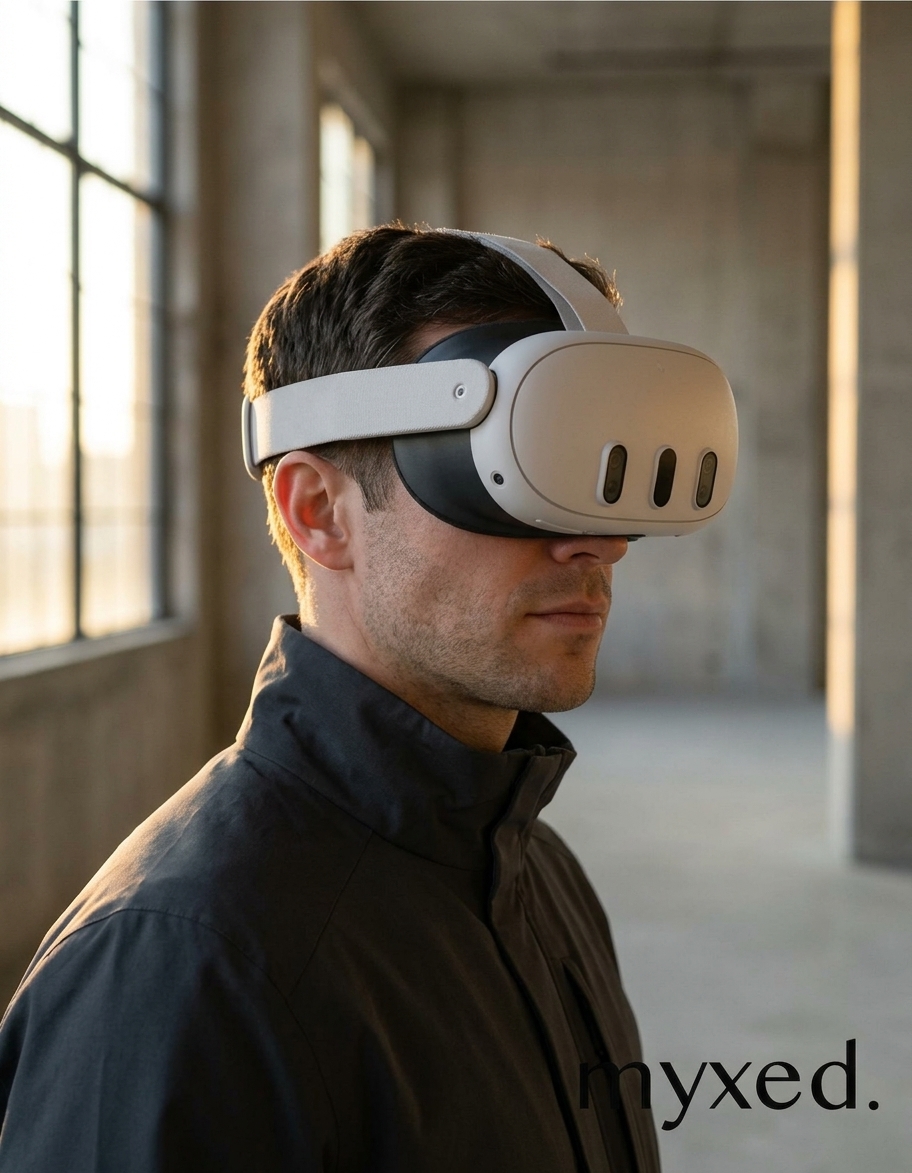
Myxed builds a digital twin of the machine from your 3D data: CAD files, point clouds, drawings. The technician puts on a Meta Quest 3 or Varjo XR-4 headset and works on this twin. He disassembles, reassembles, handles the tooling, in the real order. The scene reacts: a wrong move triggers feedback anchored in the motion, at the point where it occurs.
He trains on interventions he cannot repeat in real life, as many times as he needs. The simulator is part of the mixed reality training for industry, alongside field technical training by XR.
How a simulator session is built and run
01 The machine is rebuilt from your 3D data
CAD files, point clouds, drawings. The twin reproduces the geometry, clearances, and real access points.
02 The procedure is scripted with your experts
Disassembly order, points of attention, tightening torques, parts to protect. The expected action is defined.
03 The technician repeats, including degraded cases
Seizing, a broken part, an impossible assembly. He replays the sequence until he can handle it alone.
04 The session is scored and reported to the CMMS
Steps held, errors, time. The result feeds into the skills record of the technician.
What the simulator delivers in practice
Training for interventions that cannot be repeated in real life
Equipment in production, a rare failure, a hazardous zone: the action is repeated on the twin, not on the machine. On the real intervention, theremote expertise in mixed reality takes over.
Feedback anchored in the action
The scene signals the deviation at the moment it happens, at the point where it happens, not as a note at the bottom of a screen.
Fidelity to your equipment
The technician trains on your valve, your access points, your constraints, not on approximate equipment.
Fewer deviations on the first real intervention
The technician has already performed the action ten times by the time he stands in front of the machine.
Integrating the simulator into your system
- 3D data and digital twin. Myxed builds the simulator from your CAD files and scans. Any change to the equipment carries through to the twin.
- CMMS connection. Sessions and skills feed into SAP PM, IBM Maximo, or Infor EAM, linked to the technician and the equipment.
- Fleet management and offline mode. An administrator manages the headsets from a console. Sessions run without a network on the shop floor, with synchronization on return.
- Accounts and traceability. Each session is dated and admissible as evidence. The maintenance skills record builds up continuously.
A demo has you handle a part in a headset. An industrialized simulator is built from your 3D data, tracks changes to the equipment, feeds skills into the CMMS, and maintains an admissible record.
When the simulator is not the right answer
- The equipment is available for training. If the technician can train on the real machine without disrupting production, building a twin does not add enough value.
- The action relies on a fine physical sensation. Felt torque, assembly play, vibration: what the headset cannot render has to go through a real test bench.
- No usable 3D data exists. Without a CAD file or a scan, the equipment must first be digitized. This is a prerequisite, costed separately.
- The procedure changes with every intervention. If nothing repeats from one time to the next, there is no stable action to train.
- For a fully simulated environment, without a twin of your machine, virtual reality training is the better fit.
On the ground
A gas operator trains its technicians on the maintenance of a critical valve present on several sites. The valve cannot be taken out of service for training. On the first real disassembly, a technician used to take several hours instead of the standard time, with one or two non-conformities on reassembly.
Myxed built the twin from the CAD files and scripted the procedure with the site's experts. Technicians now repeat the disassembly on the simulator before touching the real valve. The first real pass now comes closer to the standard time, with fewer reworks on reassembly.
Measuring the effect of industrial maintenance simulation
Myxed observes roughly 40 to 75% fewer deviations on first field interventions, and a drop of about 60% in time-to-competency on trained procedures. These orders of magnitude depend on the criticality of the equipment and the starting error rate.
Before development, the indicator is chosen with the maintenance team: MTTR on the target equipment, rework rate on reassembly, deviation from standard time on the first intervention, non-conformity rate.
The Myxed method: frame, prototype, build, deploy
- Frame. With the maintenance team, choose a critical piece of equipment, a procedure, an indicator (MTTR, rework rate). Define what success looks like at six months.
- Prototype. The twin of a piece of equipment from your 3D data, a scripted procedure, tested by technicians and experts.
- Build. CMMS integration, fleet management, offline mode, accounts. The twin becomes maintainable as the equipment evolves.
- Deploy. Commissioning equipment by equipment, site by site. Technician training. Field feedback loop maintained.
Frequently asked questions
A framing workshop starts within four to six weeks. A first twin of a piece of equipment, with a scripted procedure, is tested by technicians in the following weeks, provided usable 3D data is available. CMMS integration and deployment across several pieces of equipment spread over a few months.
The amount depends on the number of pieces of equipment, the state of the 3D data, and the integrations. Published market estimates run around 25,000 to 45,000 € for a first twin with one procedure, more for a set of equipment with CMMS integration, headsets included. On a site of 200 technicians, avoided costs run between 300,000 and 800,000 € a year, for a return on investment generally between 6 and 12 months. Myxed frames the scope before any costing.
It needs usable 3D data: a CAD file, a point cloud, detailed drawings. Failing that, scanning the equipment is a prerequisite. Once the twin is built, any change to the equipment (a new part, a modified access point) carries through to the scene.
E-learning shows the procedure: video, diagram, quiz. The simulator has the technician repeat the action on your equipment, with feedback anchored in the motion. The technician does not watch a disassembly, he performs it, as many times as needed, including degraded cases.
Going further
The simulator is framed around a critical piece of equipment and a procedure, with an indicator chosen by the maintenance team. A first framing workshop can start within four to six weeks.
Also worth reading:
Voir tous les usages de la réalité virtuelle en entreprise.