The line is down. The expert is on another site.
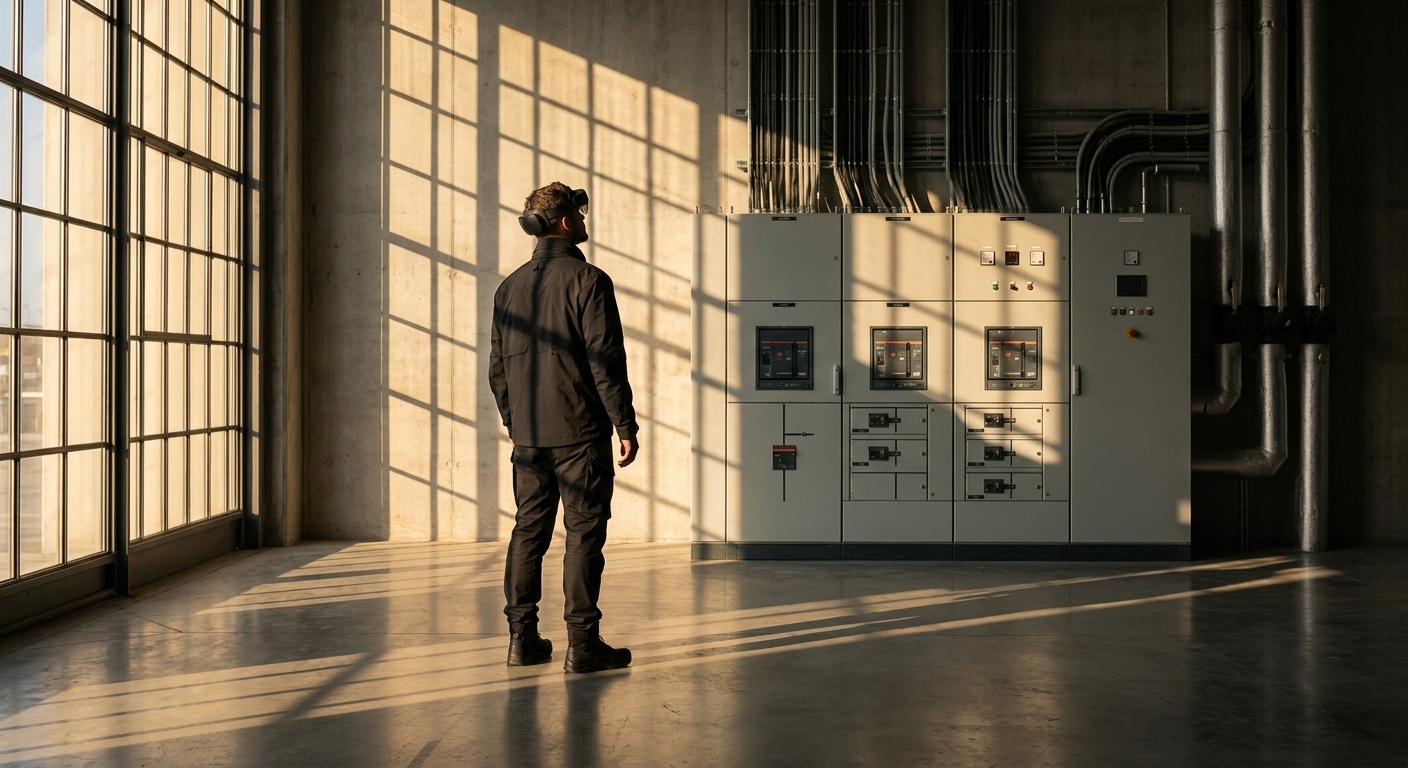
Between the call to the specialist and their arrival on site, downtime accumulates. On the phone, the expert describes a component he cannot see; the technician answers about a part he cannot show. Industrial telemaintenance through mixed reality connects the technician and the expert on the real equipment, with annotations that stay displayed exactly where action is needed.
The cost of downtime spent waiting
Critical equipment fails. The site technician knows its daily operation, not this rare fault. The specialist is at the manufacturer, at headquarters, on another site. He travels, or he guides by phone. On the phone, he describes a component he cannot see; the technician answers about a part he cannot show. The diagnosis drags on, the line stays down.
On critical equipment, an hour of unplanned downtime is measured in lost production, sometimes in delivery penalties. An expert's trip, on the other hand, is measured in half-days.
Mixed reality connects the technician and the expert on the real machine
The field technician wears a HoloLens 2 or Meta Quest 3 headset. The remote expert sees what the technician sees, in his field of view. He points, he draws on the real equipment: an arrow on a connector, a circle on a valve, a value for a torque setting. The annotation stays fixed on the component, even if the technician moves or looks elsewhere. Voice communication carries through more than 50 dB of ambient noise.
The expert acts in the technician's space, not on a screen off to the side. That is what sets telemaintenance apart from a video call. It belongs toremote expertise in mixed reality deployed across industrial sites.
How an industrial telemaintenance session unfolds
01 The technician opens the session from the equipment
From the CMMS or a shortcut, he starts the call. The available expert joins within minutes.
02 The expert sees the scene and annotates
On the first-person video feed, the expert identifies the component and places anchored annotations: which screw, which order, which value.
03 The technician executes, hands free
The annotations stay in place while he works. He checks off each step, the expert corrects live if needed.
04 The report goes into the CMMS
Parts replaced, time spent, photos, annotations: the work order closes without re-entry. The annotations feed the knowledge base.
What telemaintenance changes in practice
The delay between the fault and the expertise is measured in minutes
The expert joins the session without traveling. Diagnosis starts right away, not after a half-day on the road. This is the principle behindremote technical assistance for industry.
Fewer expert trips
The specialist handles several sites in a day. Physical travel is reserved for cases where he must put his hands on the machine. When the fault exceeds the site's know-how,remote assistance in augmented reality lets the expert diagnose from his desk, backed by annotations on the machine. Other cases are handled with a remote expert for industrial maintenance.
The rare gesture becomes traceable and reusable
Each annotated intervention feeds a living knowledge base. The next procedure builds on the previous one, not on one person's memory.
Remote commissioning without tying up the manufacturer
The manufacturer guides the installation of a new line from its own site. The customer starts up earlier, without waiting for a team on site.
Integrating telemaintenance into your system
- CMMS connection. The technician launches the session from the work order (SAP PM, IBM Maximo, Infor EAM). The report and parts data flow back without re-entry.
- Living knowledge base. An archive sorts persistent annotations by equipment. A technician can pull up the last intervention on the machine.
- Data sovereignty. Cloud hosting in France/EU or on-premise installation. Video feeds and annotations stay under your governance.
- Accounts and traceability. Each session is tied to a named technician and expert. Timestamp, duration, actions: the report can be relied on as evidence.
A demo shows a video call with a drawing on screen. An industrialized solution manages the connection in noisy areas, degraded mode when the network weakens, accounts, and archiving by equipment.
When telemaintenance is not the right answer
- The task needs two pairs of expert hands at once. If the task requires the physical presence of a second specialist, remote guidance is not enough.
- Area with no network coverage at all. Without 4G, industrial Wi-Fi, or a satellite link, the real-time session cannot hold. An offline mode, with annotations prepared and consulted later, remains possible.
- ATEX zone without certified equipment. In an explosive atmosphere, only a certified headset can enter the zone. Otherwise, guidance is given from the zone boundary.
- Simple, familiar fault. If the technician already knows the procedure, opening an expert session adds nothing. Telemaintenance serves rare or uncertain cases.
In the field
A gas compression station operator faced a recurring fault on a compressor auxiliary. The specialist for this equipment covers around ten stations from a single site. Each intervention cost him a half-day on the road, sometimes a night away.
The team equipped field technicians with HoloLens 2 headsets connected to the specialist. For this recurring fault, the technician now opens a session, and the specialist guides the diagnosis and then the repair from his desk. Travel is reserved for cases where he must put his hands on the machine. Most interventions in this scope are now handled without travel.
Measuring the effect of telemaintenance
Myxed observes roughly 50 to 70% fewer expert trips on the scopes covered. On critical equipment, the time to get up to speed on a rare procedure drops by around 75%. Downtime linked to waiting for the expert also decreases, at a rate that depends on the starting organization.
Before building anything, the indicator is chosen with the maintenance team: MTTR on the targeted equipment, number of expert trips per month, first-time resolution rate, downtime per intervention.
The Myxed method: frame, prototype, build, deploy
- Frame. With the maintenance team, choose an equipment family, a type of intervention (recurring corrective, commissioning, preventive) and a measurable indicator.
- Prototype. A first session on real equipment, with a field technician and the expert. Testing the connection in the actual zone, the annotation ergonomics, and the CMMS link.
- Build. CMMS integration, knowledge base by equipment, offline mode, accounts, hosting choice (cloud in France/EU or on-premise).
- Deploy. Site-by-site rollout. Training for technicians and experts on the session. A field feedback loop is maintained.
Frequently asked questions
A framing workshop starts within four to six weeks. A first operational session on one scope follows within the coming weeks. Full deployment, including CMMS integration and the hosting choice, spans two to six months depending on the number of sites, network conditions on site, and security requirements.
The cost depends on the number of technicians equipped, the CMMS integrations, and the hosting mode (cloud or on-premise). Myxed frames the scope before any costing. The pilot is sized against a measurable indicator, MTTR or number of trips.
Yes, with a headset certified for the zone. Without certified equipment, guidance is given from the zone boundary. Outside ATEX zones, a HoloLens 2 or a Meta Quest 3 covers most industrial cases. Communication holds through more than 50 dB of ambient noise.
Yes. The technician launches the session from the work order in SAP PM, IBM Maximo, or Infor EAM. The report, parts, and time spent flow back without re-entry. An archive sorts persistent annotations by equipment and feeds a living knowledge base.
Going further
Telemaintenance is framed around an equipment family and a type of intervention, with an indicator chosen by the maintenance team. A first framing workshop can start within four to six weeks. Response within 48 hours.
Also worth reading: