At audit time, proving who is qualified for which task
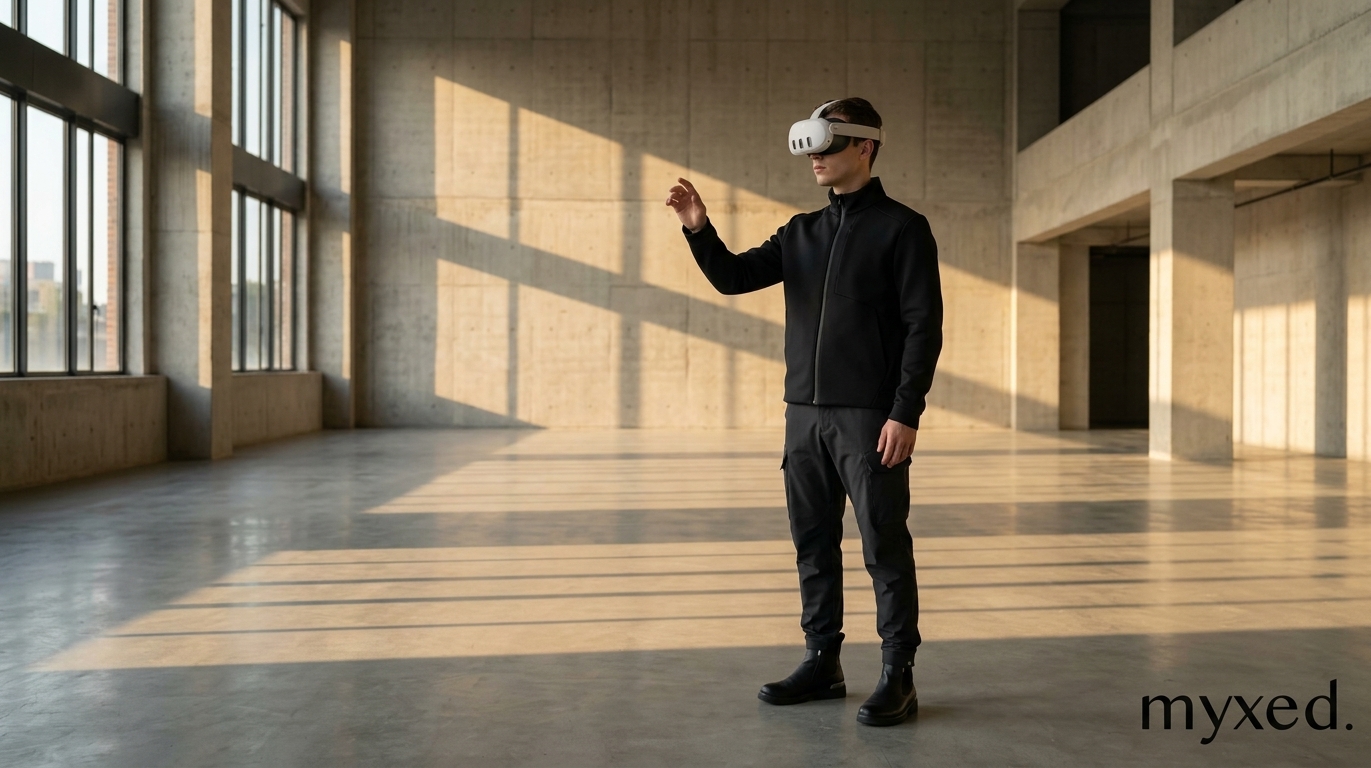
On an industrial site, proof of training often lives in a binder: sign-in sheets, signed certificates, the supervisor's memory. When an auditor asks who was trained on electrical lockout and on what date, the file gets rebuilt by hand. Mixed reality training secures the transfer of industrial know-how. Each session is recorded: the task repeated, the outcome, the date, the operator.
Training happens, proof is missing
An operator learns the job from a senior colleague, on the machine, between production runs. It works: he retains the task. But nothing keeps a record of it: not what he repeated, not how many times, not with what result. And the memory of a classic session, oral and demonstrative, fades fast: a few weeks later, only part of the procedure is performed without error.
When the QHSE department has to prove qualification for a regulated task (electrical lockout, lifting, starting sensitive equipment), it rebuilds the file from sign-in sheets and memory. Across several sites, the standard varies from one workshop to another: same procedure, different trainers, different requirements.
Mixed reality drives repetition of the task and records every attempt
The operator puts on a Meta Quest 3 or HoloLens 2 headset. He works in a scene that reproduces his workstation: the machine, the tooling, the sequence. He repeats as often as needed, fault scenarios included, without touching the real installation. The scene logs every session: steps completed, errors, time, result.
The QHSE department and HR get a dated proof of qualification, a skills dashboard, an audit-ready log. The task is trained before the situation arises. The record is built at the moment of the session, not after. This approach is part of mixed reality training for industry.
How operator training for digital industry unfolds
01 A scene that reproduces the workstation
The machine, the tooling, the environment, at full scale. The operator recognizes his workstation.
02 Free repetition, fault scenarios included
The operator repeats the task as many times as needed. He runs through degraded scenarios without risk or stopping the line.
03 Evaluation at every session
The scene logs the steps completed, the errors, and the time. A pass threshold is set with the business team.
04 The result flows into the LMS and the HRIS
Session, score, date, operator: the proof of qualification is timestamped and attached to the employee's file.
What mixed reality training changes for the transfer of industrial know-how
An audit-ready proof of qualification
For every regulated task, a dated session, a result, a named operator. The audit file builds itself continuously.
One identical standard across all sites
Same scene, same criteria, same pass threshold from one workshop to another. Training stops depending on the local trainer.
The rare, dangerous task repeated without risk
Electrical lockout, lifting, starting sensitive equipment: the operator trains before being exposed to it. For maintenance technicians, field technical training through XR covers intervention tasks.
A skills dashboard
The training manager sees who is trained, who needs to be, and which qualifications are coming up for renewal.
Integrating mixed reality training into your system
- LMS and HRIS connection. Results flow back in xAPI or SCORM format. The qualification appears in the employee's file, without double entry.
- Fleet management. An administrator manages the headsets from a console: assignment, module versions, updates pushed by site.
- Offline mode. Training runs without a network on the shop floor. Results sync once connection is back.
- Accounts and traceability. Each session is tied to a named account. The log is timestamped and holds up in an audit.
A demo has someone repeat a task in a headset. An industrialized solution pushes modules across a fleet, feeds qualifications into the HRIS, works offline, and keeps an audit-ready log. Myxed does not sell headsets: the hardware is chosen for the use case and managed as a fleet.
When mixed reality is not the right answer
- The procedure is simple and stable. A clear job aid and a demonstration are enough. Building a scene is not justified.
- Few learners are involved. For two or three people trained per year, the modeling effort outweighs the gain.
- The task requires precise physical feedback. Effort, resistance, temperature: what the headset cannot reproduce is trained on the real machine or on a test bench.
- The line can be stopped for training. If the operator can practice on the real equipment without disrupting production, the benefit stays low. For rare tasks where the line cannot stop and the environment is fully simulated, virtual reality training is the better fit.
In the field
An aerospace assembly site trains its new operators on a complex assembly procedure. Under traditional mentoring, an operator took around eight hours to perform the procedure alone, with several errors in the first week.
The team built the procedure in mixed reality : guided scene, free repetition, evaluation per session. The operator now performs the procedure alone after around three hours of training, and first-week errors drop by around 60%. These figures come from this site: Myxed frames the indicator with the business team before building anything.
Measuring the effect of immersive training
Myxed observes around 60% less time to reach proficiency on trained tasks, and field adoption of the tool around 85% once the modules are integrated into the training path. These orders of magnitude vary depending on how mature the training was to begin with.
Before building anything, the indicator is chosen with the QHSE and HR teams: time to proficiency, error rate in the first weeks, share of up-to-date qualifications, time to build the audit file.
The Myxed method: frame, prototype, build, deploy
- Frame. With QHSE, HR, and the business team, choose the regulated or critical tasks to cover first, and a measurable indicator.
- Prototype. A scene built on one procedure, tested by operators and their trainer. Adjustments to the sequence, the pass threshold, the ergonomics.
- Build. Integration with the LMS and the HRIS, fleet management, offline mode, accounts. The skills dashboard is put in place.
- Deploy. Site-by-site, task-by-task rollout. Training for local trainers. A field feedback loop is maintained.
Frequently asked questions
A framing workshop starts within four to six weeks. A first module on one procedure is tested at the workstation within 6 to 16 weeks, depending on the complexity of the task and the availability of 3D data. Integration with the LMS and the HRIS, then rollout across several sites, spans a few months.
The cost depends on the number of procedures, the fidelity of the scene, and the integrations. Published market estimates range from €25,000 to €45,000 for a first module, and from €60,000 to €120,000 for a set of procedures with LMS integration, headsets included. Myxed frames the scope before any costing.
No. It replaces the repetitions that tie up a machine, a trainer, and a production slot. Theory, group feedback, and validation on the real equipment stay in person. The module fits into the existing training path.
A Meta Quest 3 for fully simulated scenes, a HoloLens 2 for training overlaid on the real workstation, a Varjo XR-4 when visual fidelity is decisive. Myxed is hardware-agnostic and manages the fleet.
Going further
Operator training is framed around regulated or critical tasks, with an indicator chosen by the QHSE and HR teams. A first framing workshop can start within four to six weeks.
Also worth reading: