Train, troubleshoot, control, assist without stopping production
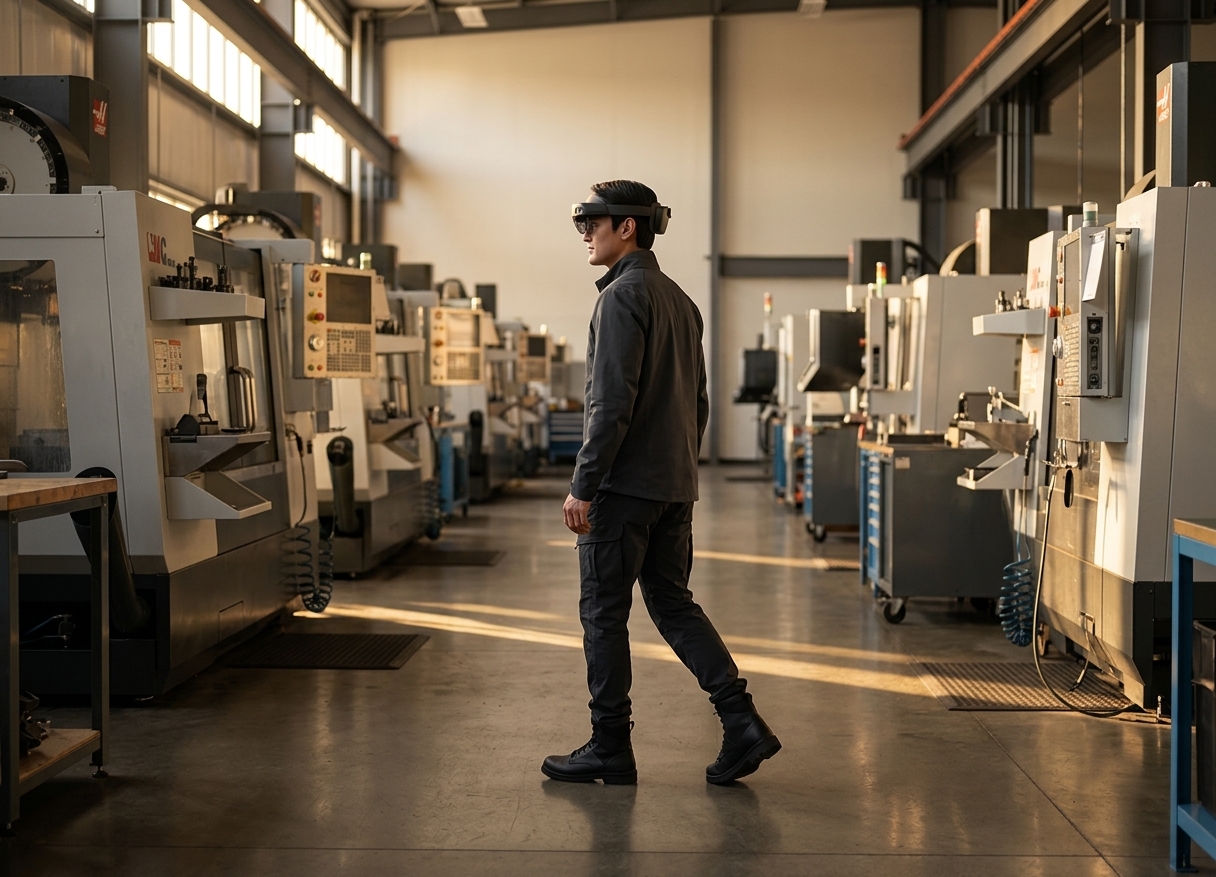
On a line, four situations recur: an operator to train without stopping the machine, a breakdown with the expert far away, a control that depends on vigilance, an expert's travel as well. Mixed reality addresses these four cases, with deployments in production since 2022 at Air France, Airbus, Valeo, KNDS, and GRTgaz.
Applications in production, not proofs of concept
Since 2022, Myxed has been deploying mixed reality applications at industrial sites. Not demonstrations: tools used every day by operators, technicians, inspectors, at Air France, Airbus, Valeo, KNDS, and GRTgaz.
Four use cases recur, regardless of the sector: train without stopping, troubleshoot with a remote expert, control without depending on end-of-shift attention, decide when to send an expert. This page details the four: immersive training, guided maintenance, guided quality control, remote assistance. It completes the overview of the use cases of mixed reality for industry.
Mixed reality overlays information where the action takes place
The common principle: digital content is placed on the real object, at the operator's scale. A procedure appears on the machine. A tolerance is set on the part. An expert's annotation remains fixed on the component. The operator keeps their hands free and eyes on the work.
The technology is composed case by case: headset, 3D engine, and connection to the information system chosen according to the task.
The four use cases of mixed reality in factories
01 Immersive training
Problem. A rare, dangerous, or costly gesture to repeat. The machine cannot be stopped for training, and the experienced worker who knew is retiring.
Solution. A scene that reproduces the workstation. The operator repeats the gesture and the failure cases without risk, as many times as needed. Each session is evaluated and tracked.
Result. Myxed observes about 60% less time to reach competency on the trained gestures.
Dedicated pages: virtual reality training ; QHSE and HR traceability ; maintenance simulator.
02 Guided maintenance
Problem. A technician works on equipment he knows little about. The procedure is on paper, in a different place than his hands.
Solution. Step-by-step guidance is displayed on the machine. Each step is validated by a gesture or by voice. The work order is closed in the CMMS without re-entry.
Result. Myxed observes 40% to 75% fewer errors in field interventions.
Dedicated page: industrial remote maintenance.
03 Guided quality control
Problem. Visual inspection depends on the vigilance and fatigue of the operator. A non-conformity that goes unnoticed costs several times its correction price downstream.
Solution. The CAD model and tolerances overlay the part. The points scroll in order, validation is done hands-free, the report goes into the quality system.
Result. Myxed observes a 30 to 45% reduction in inspection time, with equal or greater control coverage.
Dedicated page: quality control guided by mixed reality.
04 Remote assistance
Problem. An additional expert visit. The specialist spends their day driving for a fifteen-minute diagnosis.
Solution. The remote expert sees what the technician sees and annotates the actual equipment. The annotations remain anchored on the component during the work.
Result. Myxed observes a 50 to 70% reduction in expert visits in the covered areas.
Dedicated page: assistance and remote maintenance.
What mixed reality brings, regardless of the case
The guided gesture at the moment it is performed
The information is on the object, not in a binder or on a screen next to it.
A traceability established at the moment of the act
Session, control, intervention: each validation is recorded when it occurs.
An identical standard from one site to another
Same scene, same criteria, regardless of the workshop or team.
A system managed like a park
Headsets, versions, and accounts managed from a console, not a handful of devices sitting on a shelf.
Integrate mixed reality into your systems
- Link to the business information system. LMS and HRIS for training, CMMS for maintenance (SAP PM, IBM Maximo, Infor EAM), quality system for control. REST API connectors and standard formats.
- Fleet management. Assignment, versions, updates pushed by site from an administration console.
- Offline mode. Applications run without a network in the workshop, with synchronization upon reconnection.
- Accounts, traceability, sovereignty. Each action is attached to a named account. Cloud hosting FR-EU or on-premise.
A proof of concept shows usage on a workstation. An industrialized solution manages the fleet, accounts, offline mode, connection to the information system, and recovery after network interruption.
When mixed reality is not the right answer
- The need is occasional. For use a few times a year on a single workstation, the construction effort is not justified.
- The gesture relies on a fine physical sensation. Effort, torque, temperature: the headset does not reproduce them.
- A reference digital data is missing. Without CAD model, control plan, or 3D data, the scene has nothing to overlay.
- The process is already fully automatable. If vision cameras and stable criteria are sufficient, an automated system is more suitable.
On the ground
An industrial group started with a unique case: training on a complex assembly procedure at an aerospace site. The result on the duration of skill acquisition was significant.
The group then extended the approach to the guided maintenance of critical equipment, and then to the quality control of a subset. Each case was framed separately, with its indicator. The infrastructure (fleet, accounts, connection to the information system) was pooled among the three.
Measure the effect, case by case
The four cases do not have the same indicator. Training: duration of skill acquisition, about 60% less. Guided maintenance: field error rate, 40 to 75% less. Quality control: inspection time, 30 to 45% less. Remote assistance: number of expert trips, 50 to 70% less. The return on investment generally ranges from 6 to 12 months.
These orders of magnitude vary according to initial maturity. Before developing, the indicator is chosen with the relevant business, measured before and after.
The Myxed method: frame, prototype, build, deploy
- Frame. One case, one scope, one measurable indicator. Define what success looks like in six months.
- Prototype. A first scene on a real situation, tested by the teams on site.
- Build. Connection to the information system, fleet management, offline mode, accounts. The application becomes maintainable by your teams.
- Deploy. Commissioning post by post, then site by site. Field feedback loop maintained.
Frequently asked questions
Aerospace, energy, rail, defense, automotive, heavy manufacturing, luxury. The common point is not the sector: it is a gesture that is difficult to repeat, diagnose from a distance, or control visually. Myxed has been deploying in these areas since 2022.
A scoping workshop starts within four to six weeks. A first case goes into production in a scope in three to six months, depending on the complexity of the gesture, the state of the 3D data, and the integrations into the information system.
In ATEX zones, with a certified headset for the area, otherwise from the edge of the zone. In ISO clean rooms, the equipment is chosen for cleanliness constraints. Extreme temperatures limit the wearing time and influence the choice of headset.
Myxed does not sell headsets. The equipment (HoloLens 2, Meta Quest 3, Varjo XR-4, Apple Vision Pro, Pico) is chosen according to the use case and managed like a fleet. Hardware agnosticism is a design principle.
Go further
Each case is scoped separately, with its own indicator, on a pilot scope. A first scoping workshop can start within four to six weeks.
Discover the use cases in detail: