Apple Vision Pro in the Enterprise — Adoption, Limitations and B2B Use Cases
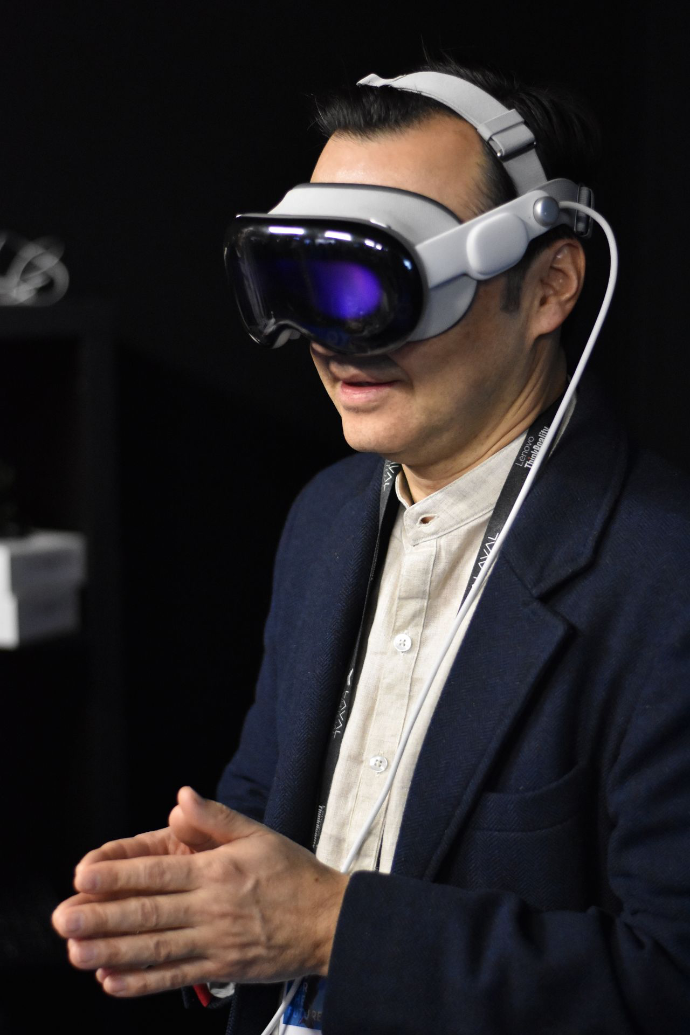
The Apple Vision Pro is the most technically impressive spatial headset on the market. Its micro-OLED display (23 million pixels per eye), video passthrough and EyeSight interface make it a remarkable technological demonstration. But spatial computing meets industrial reality: weight, battery life and field durability remain constraints for outdoor industrial use.
23 M
pixels per eye (dual micro-OLED displays), the highest density of any commercial headset — vs 2 M for HoloLens 2.
Source: official Apple specifications
100°
diagonal field of view, the widest in the consumer AR/MR market — versus 52° for HoloLens 2.
Source: official Apple specifications, 2024
€3,499
entry point for premium design teams. Quest 3: €549. HoloLens 2 discontinued in 2024.
Source: official Apple, Meta pricing
Unmatched display quality
23 million pixels plus micro-OLED: flawless reading of the finest text, detailed technical diagrams and high-fidelity 3D models. For applications where visual precision is critical, Vision Pro has no equivalent.
01
02
Hand tracking, spatial audio and a dual-app interface enable natural collaboration for remote design reviews and training scenarios in controlled environments.
02
03
The external display shows the user's eyes to onlookers — reducing isolation in shared spaces. Ideal for executive presentations and collaborative review studios.
03
Strengths in controlled environments; field limitations
Industrial reality: where Vision Pro reaches its limits
Industrial reality: where the Vision Pro reaches its limits
Design review ✓ | Field maintenance ✗ | Outdoor AR overlay ✗
Weight and comfort
A 600 g headset plus an external battery via USB-C means a tethered setup. Impractical for 4- to 8-hour shifts on the factory floor or outdoor sites. HoloLens 2 was lighter; the RealWear Navigator 520 (~300 g) is designed for extended wear.
No field ATEX certification
Cannot be deployed in explosive atmospheres (chemical plants, gas facilities, mines). The RealWear 520 holds ATEX and IECEx certifications; Vision Pro does not.
No autonomous outdoor spatial tracking
The Vision Pro's LiDAR and indoor tracking assume controlled lighting. No support for outdoor AR overlay on machines without geolocation/BLE. Not suited to outdoor asset inspection without custom application architecture.
Battery and cabling
2 hours of tethered battery life limit deployment flexibility. For comparison: HoloLens 2 offered ~2.5 hours untethered; Quest 3 offers 2.2 hours but is cheaper to replace; the RealWear 520 runs 8+ hours on AA batteries.
Vision Pro vs HoloLens 2: which fits your use case?
Apple Vision Pro excels at:
- Display quality: 23 M pixels vs 2 M for HoloLens 2 — superior for CAD and architectural visualization
- Immersive training: the visionOS ecosystem supports rich spatial simulations
- Executive presentations: EyeSight and gesture control impress in meeting rooms
- Design review: color accuracy and resolution beat HoloLens for design work
HoloLens 2 used to excel at:
- Industrial durability: hands-free AR, built for workshops and harsh environments
- Application ecosystem: established integration with Dynamics 365, SAP, Power BI
- Hands-free operation: eye and voice control for workers with their hands full
- Verdict: Vision Pro is the best choice for design work in controlled environments. For outdoor industrial AR and field maintenance, consider the RealWear Navigator 520 or wait for HoloLens 3 (expected 2026–2027).
Ready to evaluate Vision Pro for your team?
Our team can help you determine whether Vision Pro fits your use case — or point you toward RealWear or other alternatives if field durability is critical.
Frequently asked questions
Questions from industrial buyers evaluating Vision Pro for enterprise deployment.
Not in the short term. As of 2026, the Vision Pro's enterprise software ecosystem is still developing. For guided maintenance, remote expert assistance and field deployments, the HoloLens 2 remains better suited — and its successor is expected in 2026–2027. Vision Pro excels in design review studios and meeting-room presentations.
Yes. Apple Business Manager supports Vision Pro with configuration and restriction profiles. MDM compatibility: Jamf, VMware Workspace ONE, Microsoft Intune (visionOS support in progress). Fleet deployment is possible but requires enrollment procedures specific to visionOS.
Unconfirmed rumors point to a Vision Pro 2 in 2026–2027 with better battery life and a lower price. Apple has positioned the Vision Pro as a productivity platform, not a field industrial tool: a future model certified for ATEX or built for harsh environments looks unlikely.